

The Growth Strategy Nobody Teaches You
You’re three hours into a task you hate, and you suddenly realize you’ve gotten almost nothing done. Your inbox is a graveyard. Your coffee went cold an hour ago. And meanwhile, the thing you’re actually brilliant at, the work that would move your business forward, is sitting untouched all day.
Here’s what I want you to hear: that frustration is data. It’s the most important data point in your business right now, and many entrepreneurs and business owners disregard it.
The fastest path to growth as a business owner starts with going deeper into what already works. The entrepreneurs who scale, the ones who build something that lasts, get radically honest about what they’re great at and build everything else around that center of gravity. Strengths first. Team and systems around the gaps.
That kind of self-awareness sounds simple, and the execution is quietly brutal. Because it requires being honest about who you actually are.
Why Entrepreneurs Try to Do Everything Themselves
Let me ask you something, and I want you to answer honestly. How much of your week do you spend on tasks that drain you? Tasks where you’re functional, maybe even competent, but the energy it takes to get through them steals from the work where you genuinely shine?
For most business owners between years two and seven, that number is somewhere around 60 to 70 percent. And the wild part is, they know it. They feel it every single day. They feel the drag that comes from spending their best hours on their worst work.
So why do they keep doing it?
Because somewhere along the way, they picked up a belief that “real” entrepreneurs handle everything. That asking for help signals weakness, and the badge of honor belongs to the founder who does it all, even when doing it all means doing most of it badly.
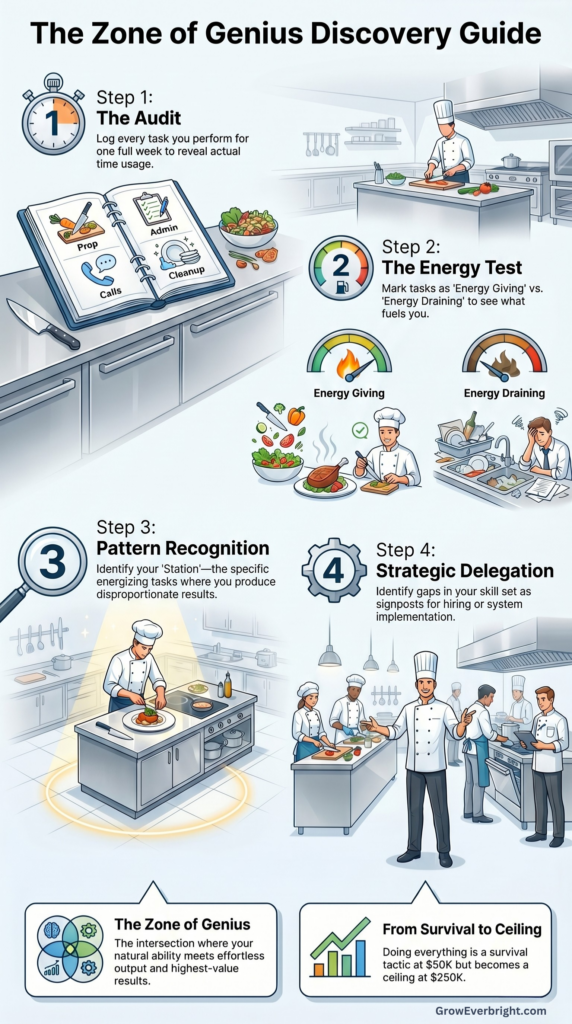
That belief served you when you were starting out with no money, no team, and no leverage. At $50K in revenue, handling everything was a matter of survival. By $250K, it becomes the ceiling. By half a million, it becomes the weight that finally breaks the floor.
This pattern is so persistent because it lives in your identity, in how you see yourself as a founder. Changing a business strategy takes an afternoon. Changing a belief about who you are takes courage and time, and most growth advice completely ignores that distinction. The question worth sitting with is this: “Am I willing to let go of the version of myself that needs to do everything?”
The Kitchen: Know Your Station
You’ve eaten at a restaurant where the food was so good you remembered it for months. Maybe years.
Now think about what’s happening behind that kitchen door.
The head chef is almost certainly not cooking. In a professional kitchen, the executive chef sets the menu, establishes the standard, develops the creative vision, and tastes everything that goes out. The sous chef runs the line. The line cooks execute each dish. The prep team builds the foundation hours before service even begins. The head chef’s highest contribution is the vision and the palate, the ability to taste a sauce and know instantly whether it meets the standard. Their genius is leadership, and the kitchen performs at its peak specifically because they trust every other station to do what it does best.
Meanwhile, every one of those other roles matters enormously. The restaurant fails if the dishes pile up, if the walk-in goes unrestocked, or if the front-of-house falls apart. And every one of those functions runs because someone whose skills matches that station has ownership of it.
This is how a strengths-based business works. You identify your station, the function where your particular genius creates the most value, and you build a kitchen around it where every other station is covered by someone operating from their own center of gravity.
Most entrepreneurs are running a restaurant where they’re simultaneously the head chef, the dishwasher, the hostess, the bookkeeper, and the line cook. The food, the actual product that makes the whole business worth existing, suffers. Every time. Because excellence and split attention have never coexisted in any kitchen, anywhere.
How to Identify Your Real Strengths as a Business Owner
Before you can own your station, you need to design your menu. And this is where most entrepreneurs get vague, which costs them real money.
“I’m good with people.” Great. What does that mean? Are you the person who walks into a room of skeptics and makes every one of them feel heard? Or are you the person who can take a 47-page technical document and translate it so a sixth grader would understand it? Those are wildly different strengths, and they lead to wildly different business strategies.
Gay Hendricks popularized the zone of genius concept, and it’s a useful starting point. The short version: your genius zone is the work that energizes you while producing disproportionate results. Where natural ability meets effortless output.
I’d push you further than that, though. Your zone of genius tells you the category. The texture and flavor of your talent, the way you do what you do, is what differentiates your business in a crowded market.
Here’s a practical exercise that can reshape your entire approach. For one week, log every task you do. Next to each one, mark whether it gave you energy or drained it. Yes, this takes a few minutes every day. Do it anyway. At the end of the week, look at the pattern. The tasks that energize you are your station. Everything else belongs to someone who’d thrive in it and who’s waiting for the opportunity.
This is the self-awareness work that drives sustainable scaling. And it maps directly to market positioning, because the clearer you are about the specific shape of your strengths, the more precisely you can articulate what makes your business the obvious choice.
Five Scenarios You’ll Recognize
Here’s where this gets real. I guarantee you’ll see yourself in at least one of these, or you’ll know another founder who’s living it right now.
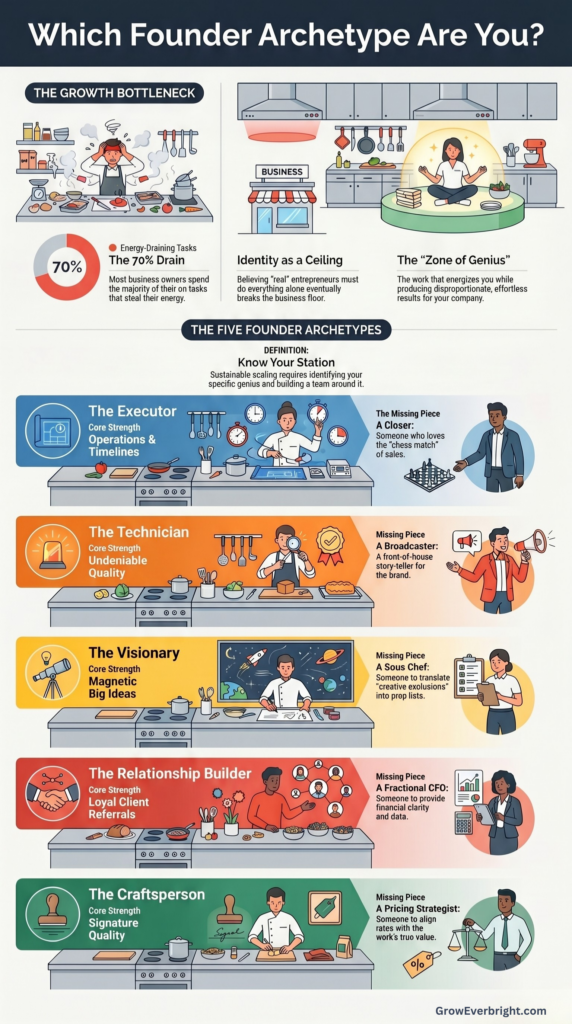
The Executor Who Dreads Sales Calls
You can build a project timeline, a launch sequence, and an operations manual that would make a Fortune 500 COO weep with joy. When you commit to a deliverable, it lands on time, under budget, at a quality level that keeps clients coming back.
And every time you get on a sales call, you feel like you’re wearing someone else’s shoes two sizes too small. You white-knuckle your way through the pitch and tell yourself you’ll get better with practice.
Meanwhile, there’s someone out there who lights up at the sound of an objection and treats closing like a chess match they were born to win. That person needs your structure and operational rigor as desperately as you need their ability to close. The right sales hire completes the circuit, your close rate jumps, and every one of those deals gets executed flawlessly. Because that’s your station.
The Technician Whose Work Speaks for Itself (When Anyone Can Find It)
The quality of your work is undeniable. Your portfolio, once someone actually sees it, does all the selling for you. The problem is getting people to see it.
You’ve tried blogging, social media, running ads. Every hour you spend trying to articulate why your work matters is an hour stolen from the work itself. Your content feels flat because you’re a builder who’s been forced into the role of broadcaster, and those are fundamentally different muscles.
What you need is someone who specializes in articulating what makes businesses exceptional, a marketing partner who can be the front-of-house to your kitchen and make sure the dining room is full so your food gets the audience it deserves.
The Visionary Who Can’t Manage the Kitchen
You have seventeen ideas before breakfast. You’re magnetic, inspiring, the kind of founder people want to follow. The big picture is so vivid in your mind that it practically projects itself onto walls.
And your team is quietly drowning. Priorities shift every week. “Just figure it out” has become your management style. You’re generating creative energy at a rate that exceeds your organization’s ability to absorb it, and you’ve been interpreting that as a people problem when it’s actually a structural one.
Your team can’t keep up. They need a sous chef who translates your 7 a.m. creative explosion into a prep list the team can follow by 9. That’s how you stop being the bottleneck in your business: recognizing that your genius is the vision, and someone else’s genius is the system that brings it to life.
The Relationship Builder Who Avoids the Numbers
You have deep, loyal client relationships. Referrals come effortlessly. The warmth you bring to every interaction is the foundation your entire business stands on.
And you have absolutely no idea whether you’re actually profitable. You avoid your financials the way most people avoid the dentist, and because you price by feel rather than by data, you can’t make confident decisions about growth, hiring, or investment.
A fractional CFO or a sharp bookkeeper changes this overnight. All of that extraordinary front-of-house energy becomes exponentially more powerful when it sits on top of financial clarity. The relationship-building is your genius. The numbers are someone else’s. Let them cook.
The Craftsperson Who Undercharges
You create at a level that stops people in their tracks. Your work has a signature quality that anyone who’s hired you recognizes immediately.
And you price it based on what feels comfortable rather than what the market will bear. You’ve internalized a story about what your work “should” cost, and that story was probably written by fear, the quiet kind that says charging more means losing people.
A pricing strategist, a business coach, or a peer group that challenges your money mindset will help you see this clearly: your craft is the meal. Your pricing is what pays for the ingredients, the kitchen, the team, and the future. A restaurant that serves extraordinary food at a cost goes out of business. The quality of the food earns the price. So does your work.
Mise en Place: Building a Business That Runs Like a Great Kitchen
There’s a concept in professional cooking called mise en place. Everything in its place. Before a single order comes in, every ingredient is prepped and every station is ready. The kitchen moves as one organism because everyone knows their role.
That’s what strengths-based business growth looks like at full maturity. You at your station. Your team at theirs. Every element prepped and positioned so that when the orders come in, the whole operation moves without friction.
Building a team around your strengths goes beyond hiring for your gaps. The real goal is a culture where every person operates from their own zone of genius and knows their station matters. A sous chef who runs a flawless line is as vital as the head chef who designed the menu. A front-of-house manager whose warmth fills the dining room is delivering the first bite of the experience before any food ever arrives.
When you build like this, something shifts in how the market perceives you. Your authority becomes effortless because the whole operation is running from a place of genuine alignment. Customers sense it in how your team shows up. Your content carries it because the message finally matches the reality. That kind of coherence is impossible to fake and extremely difficult to compete with.
The Inner Game That Drives the Outer Results
Every external business decision you make is downstream from an internal belief you hold about yourself. Your pricing reflects your self-worth. Your willingness to delegate reflects your capacity for trust. How you define your ideal client reflects how clearly you’ve defined your own identity. These feel like separate business problems. They’re the same problem, showing up in different rooms of the same building.
Revenue follows identity. Your P&L is a trailing indicator.
When you operate from your center of gravity, everything downstream shifts. Messaging gets clearer. Offers sharpen because they reflect what you actually do best. Hiring gets smarter because you know exactly what the kitchen needs. Pricing reflects your real value because you’ve stopped apologizing for it.
The businesses that grow sustainably, the ones that scale past the founder’s personal capacity without losing their soul, are built by people who did this inner work. They got honest about who they are, got specific about what they bring, and found the courage to let that clarity become the foundation of everything they build.
Self-awareness is the growth strategy with no ceiling. Every other tactic performs better when it’s built on a foundation of genuine self-knowledge. The best kitchen in the world still depends on a chef who designed the menu with intention and leads every service knowing exactly why each dish belongs.
Your Move
The thing you think is your biggest liability is actually your clearest signal about where to invest. Every gap in your skill set is a signpost pointing toward the person, the tool, or the system that completes the picture.
So here’s the question: What’s your station?
Get specific. Get honest. And then build the kitchen that lets you stay there.
Grow Everbright helps entrepreneurs and business owners articulate what makes them exceptional and build the content strategy that makes sure the right people hear it. If your strengths are clear but your message hasn’t caught up yet, let’s talk.
Frequently Asked Questions
How do I know my strengths as a business owner?
Track every task you perform for one full week, and mark whether each one gave you energy or drained it. The pattern will reveal your zone of genius; the work that produces disproportionate results while energizing you rather than depleting you. Pay attention to the specific flavor of your strength, because “good with people” means something very different depending on whether your gift is persuasion, empathy, teaching, or negotiation.
Should I hire for my weaknesses?
In most cases, yes. The return on investing in your strengths is significantly higher than the return on trying to become adequate at your weaknesses. The most effective move is to identify the weakness that’s costing you the most, either in revenue, time, or energy, and fill that station first. A single strategic hire in an area where you’re struggling can free up enough capacity to transform your output in the areas where you’re already exceptional.
What is a zone of genius in business?
The zone of genius, a concept from Gay Hendricks’ book The Big Leap, describes the intersection of your natural ability and effortless output, the work that energizes you while producing your highest-value results. In a business context, your zone of genius is the station you should never leave: the core function where your specific skills create the most value for your clients and your company.
How do I stop being the bottleneck in my business?
The bottleneck almost always lives in the founder’s unwillingness to release control over functions outside their core genius. Start by identifying which tasks you’re holding onto out of habit or fear rather than strategic necessity. Then build the team, the systems, or the partnerships that allow those functions to run independently. Your role as a founder is to lead from your strengths, and to trust your team to lead from theirs.